



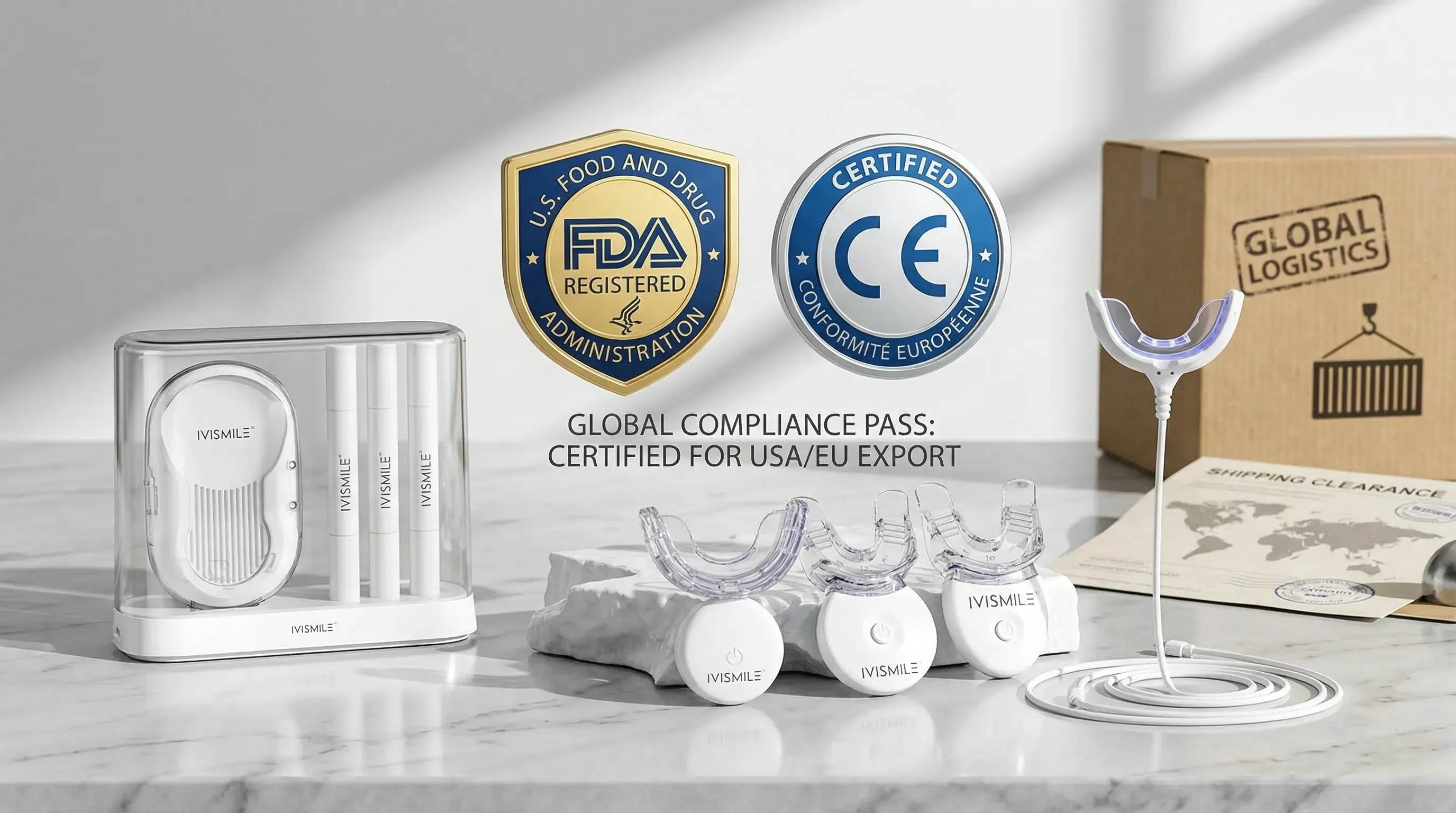
 For any oral care brand looking to expand in 2026, the global market offers massive potential. However, the path to success is paved with regulatory hurdles. Importing teeth whitening kits to the USA or the European Union (EU) is not just about finding a supplier; it’s about navigating a complex legal landscape. One single mistake in documentation or an unapproved ingredient can lead to customs seizures, hefty fines, or permanent bans on platforms like Amazon and TikTok Shop.
This comprehensive roadmap breaks down everything you need to know about FDA and CE compliance, ensuring your professional whitening kits reach your customers safely and legally.
-
Why Compliance is Your Biggest Competitive Advantage
In the B2B world, “Cheap” is no longer the primary driver—”Compliant” is. When you can prove your products meet FDA and CE standards, you aren’t just selling a product; you are selling security.
- Risk Mitigation: Avoid the “Red Errors” in your Google Search Console or Amazon Seller Central caused by restricted product flags.
- Brand Authority: Professional buyers (dentists, salon owners, and distributors) only partner with brands that hold verified certifications like ISO 13485 or CPSR.
- Global Scalability: A compliant product in the US and EU can easily be adapted for markets in Australia, Canada, and the Middle East.
-
Navigating the USA Market: FDA Requirements
The U.S. Food and Drug Administration (FDA) regulates teeth whitening products primarily based on their intended use and chemical composition.
Product Classification: Cosmetic vs. Medical Device
In the US, most whitening gels (CP/HP) are considered cosmetics. However, if your kit includes high-intensity LED lights or makes specific therapeutic claims (e.g., “cures gum disease”), it may be classified as a Class II Medical Device.
The Essential Checklist for US Imports:
- FDA Establishment Registration: Your manufacture must be registered with the FDA. This provides a Facility Establishment Identifier (FEI) number, which is required for customs entry.
- Ingredient Safety (GRAS): Ingredients must be “Generally Recognized as Safe.” High concentrations of Hydrogen Peroxide must be labeled with clear usage instructions to prevent tooth sensitivity or chemical burns.
- Labeling Compliance: Your packaging must include a full ingredient list (INCI), net quantity, and the name/address of the distributor.
-
Conquering the European Market: The Strict EU/UK Standards
The EU has the world’s most rigorous safety standards for oral care. If you plan to import teeth whitening kits to the EU, you must understand the “0.1% Rule.”
The Peroxide Restriction
Under EU Directive 2009/90/EC, any product sold directly to consumers cannot contain more than 0.1% Hydrogen Peroxide.
- The PAP+ Revolution: Because of this limit, PAP+ (Phthalimidoperoxycaproic Acid) has become the go-to formula for the EU. It provides professional results without the legal risks of peroxide.
Mandatory EU Documentation:
- CPSR (Cosmetic Product Safety Report): This is a non-negotiable document signed by a qualified toxicologist. It proves the product is safe for human use.
- CPNP Notification: Before selling, your product must be registered on the Cosmetic Products Notification Portal.
- Responsible Person (RP): You must appoint a legal representative based in the EU to handle regulatory inquiries.
-
Technical Compliance for Electronic Components (LED Lights)
Many kits include an LED accelerating light. This adds another layer of compliance: CE and RoHS.
- CE Marking: Indicates the device meets EU safety, health, and environmental protection requirements.
- RoHS: Ensures the electronic parts do not contain hazardous substances like lead or mercury.
- Electromagnetic Compatibility (EMC): Ensures your LED light doesn’t interfere with other electronic devices.
-
Comparison Table: USA vs. EU Compliance
This table serves as a quick reference for B2B buyers planning their global inventory.
| Feature | USA Market (FDA) | European Union (CE/CPSR) |
| Primary Regulator | FDA | EU Commission / National Authorities |
| Ingredient Limit | Generally flexible (labeling focus) | Max 0.1% Hydrogen Peroxide |
| Product Safety File | SDS (Safety Data Sheet) | CPSR (Mandatory & Detailed) |
| Facility Requirement | FDA Establishment Registration | ISO 22716 (GMP) |
| Electronic Safety | FCC (Recommended) | CE & RoHS (Mandatory) |
| Best Formula Choice | Carbamide Peroxide / PAP+ | PAP+ (Legal & Viral Trend) |
-
How to Avoid Customs Seizures: A 3-Step Strategy
Even with the right certificates, shipments can get stuck. Follow this protocol:
- Request a “Compliance Folder”: Before shipping, ask your supplier for a full set of documents: MSDS, ISO certificates, and Lab Test Reports.
- Verify Labeling Twice: Ensure the “Country of Origin” is clearly marked and that no medical claims are made on the box that could trigger a 510(k) requirement.
- Use a Specialized Broker: Work with a freight forwarder who has experience in medical and cosmetic imports.
FAQ: Frequently Asked Questions
Q1: Can I sell 35% Carbamide Peroxide in the EU?
No. Professional-strength peroxide (over 0.1%) can only be sold to dentists in the EU. For retail and TikTok Shop sales, you must use peroxide-free formulas like PAP+.
Q2: What is an SDS, and why do I need it?
An SDS (Safety Data Sheet) outlines the chemical properties, hazards, and safety precautions of your whitening gel. Airlines and shipping lines require this to classify the cargo (e.g., whether it’s “Dangerous Goods”).
Q3: How long does it take to get a CPSR for my private label brand?
Typically, a CPSR takes 2–4 weeks, as it requires stability testing and toxicological review. At IVISMILE, we streamline this process for our B2B partners.
Q4: Does my FDA registration expire?
Yes. FDA facility registrations must be renewed every two years (between October and December of even-numbered years).
Conclusion: Partnering for Success
Importing professional whitening kits doesn’t have to be a nightmare. By focusing on FDA and CE compliance from day one, you build a brand that is built to last.
At IVISMILE, we don’t just manufacture products; we provide a global compliance ecosystem. From providing CPSR-ready PAP+ formulas to ensuring all our LED lights are CE-certified, we handle the technical heavy lifting so you can focus on marketing and sales.
Ready to launch your compliant whitening brand in the USA or EU? Contact our compliance experts today to request our latest compliance whitepaper!
Post time: Mar-19-2026